Entertainment Is the First Mass Consumer Market for Humanoid Robots
And breaking them in public is the fastest way to make them safe.
Xenia Bulatov, Co-founder, Ultimate Bots · July 8, 2026
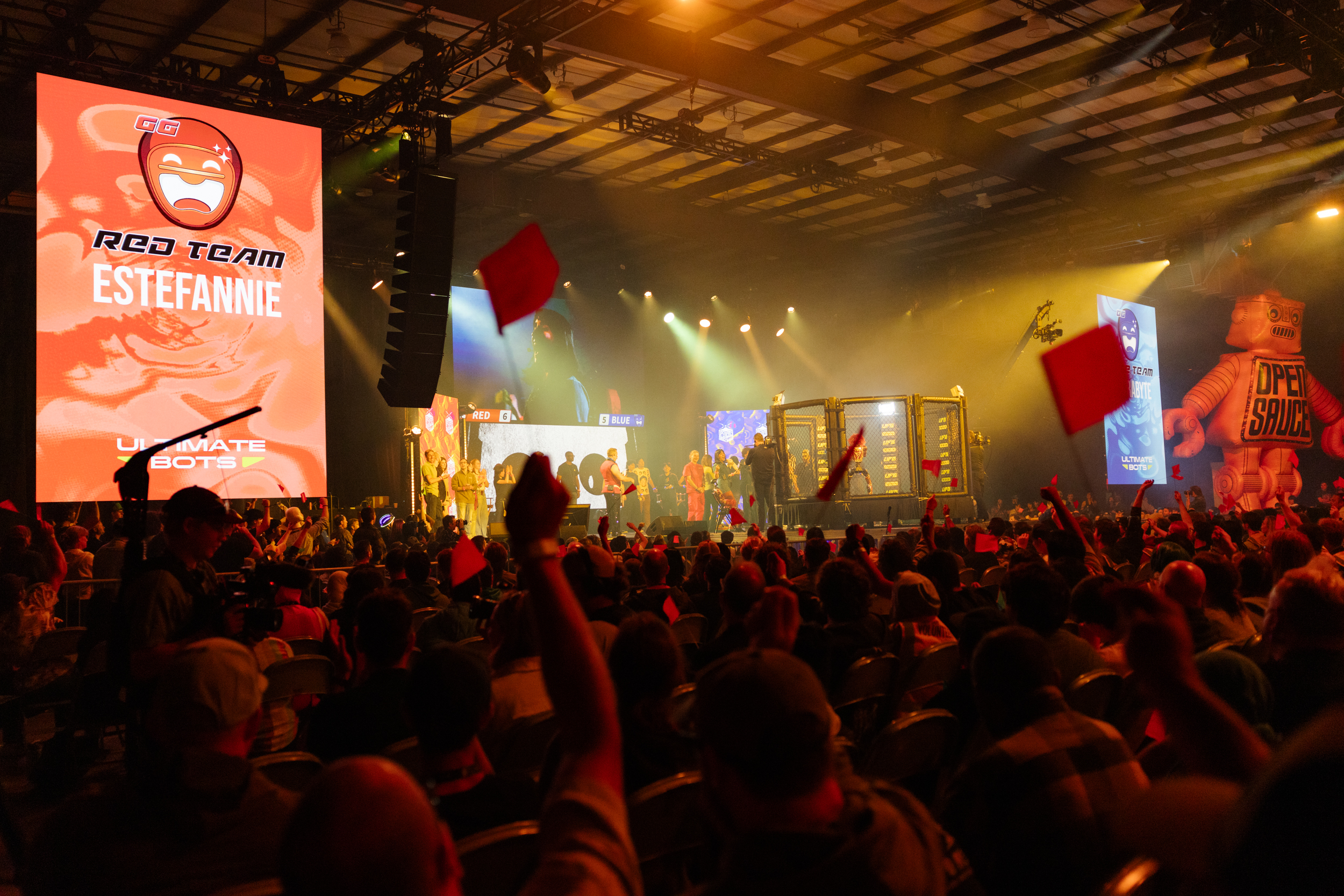
Every humanoid robot company is racing toward the same two destinations: the factory and the home. Both are years out. Both demand a level of reliability nobody has proven yet. And both are being pursued the same way — quietly, in labs, behind NDAs, with the failures edited out of the demo reel.
There is a third destination that is open right now, and it is the one that gets us to the other two faster.
Entertainment. Sport. A crowd, a floor, a robot doing something hard in front of people who paid to watch.
This isn't a consolation market while we wait for the real ones. It is the first mass consumer market for humanoids, and it does two things no lab can do: it makes robots better under conditions that actually resemble the world, and it makes people want them.
Stream one: we break robots so the industry doesn't have to
Robotics has a failure problem, and it isn't that robots fail. It's that nobody is allowed to let them.
A warehouse pilot can't fail — it stops a line. A hospital deployment can't fail — someone gets hurt. A home robot can't fail — it ends the company. So the entire field optimizes for not failing in front of anyone, which means the hard failure data gets generated slowly, privately, and in conditions engineered to be forgiving.
We run the opposite play. In our league, failure is the show. A robot that stumbles mid-round is a moment, not a lawsuit. A policy that collapses under an unexpected contact force is content and a data point in the same instant. We are the only environment in Physical AI where breaking the robot is a feature of the business model.
That changes what we can learn. Ten shows across San Francisco, Los Angeles, and Las Vegas in year one. Live floors, real crowds, hot lights, unreliable Wi-Fi — doing contact-heavy work in front of thousands of people. Every one of those nights generates the category of data the field is starved for: what a humanoid does at the edge of its competence, in an environment nobody got to sanitize first.
That's the sim-to-real gap, and we're standing in it. Not modeling it — standing in it, every event, with a load-in deadline. Deployment is the wall most robotics companies hit after the demo works, and we hit that wall ten times a year on purpose. The unglamorous work — calibration under stage lights, thermal drift in hour three, network loss mid-motion, safety envelopes for a robot two meters from a paying crowd — is the work that separates a lab result from a product.
The more robots we break, the faster the industry gets robots that don't.
Formula 1 figured this out seventy years ago. Disc brakes, sequential gearboxes, hybrid energy recovery, telemetry, carbon composites — the racetrack was the proving ground and the road car was the beneficiary. The same is true on safety, and more dramatically: the HANS device, the halo, survival cells, crash structures were all forged by crashing cars in public at 200 miles an hour. Motorsport didn't get safer despite the crashes. It got safer because of them, at a pace no closed test program would have funded.
The difference between F1 and a corporate test track was never the engineering. It was that F1 sold tickets while it did the engineering. The R&D paid for itself and drew a crowd.
That's the model. We're running it for humanoids.
Stream two: desire is a prerequisite, not a nice-to-have
Here is what the spec-sheet crowd keeps getting wrong. Mass adoption of a consumer technology is not gated on capability alone. It's gated on wanting.
Nobody bought a car because of horsepower figures. Nobody bought a smartphone because of a jobs-to-be-done matrix. People buy the thing they've already decided they want, and then they justify it with the checklist. Desire comes first. Trust comes underneath it. And trust in an unfamiliar technology — one shaped like a person, with a century of hostile fiction attached to it — does not get built by a product launch. It gets built by years of positive, repeated, emotionally legible exposure.
That's a cultural project, and it takes as long as the engineering. Which is exactly why the smart brands start early.
Formula 1, again. The sport's American breakout wasn't an engineering achievement, it was a narrative one. ESPN averaged just over 550,000 viewers a race in 2018. In 2025 it averaged 1.3 million — close to triple, in seven years — and the growth came disproportionately from women and Gen Z, audiences the sport had never held. What changed wasn't the cars. It was that people met the drivers, learned the rivalries, and got a reason to care.
Ferrari doesn't sell a drivetrain. It sells fifty years of Sunday afternoons. That's the asset, and it was built one race at a time.
Humanoids need the same thing, and right now they don't have it. What the public has instead is a stack of stiff demo videos and a century of fiction written to make them afraid. We're building the counter-narrative: robots as creations, pilots and ghosts as their teammates, a league where humans and robots win together. Flesh and steel on the same team.
That's why we run in front of crowds and not in a lab. Open Sauce with twenty-plus creators piloting. A robot on stage across a sold-out arena Joji Solaris tour this summer, with tens of thousands of people chanting at it. 50M+ impressions in year one. Every one of those is a person meeting a humanoid in a context where the feeling is joy rather than threat. Do that a few million times and you've built the thing robotics can't buy later: permission.
The window is now, and it closes
Formula 1 did $3.87 billion in revenue in 2025. It sits on top of the automobile — a category that took a century to reach scale.
Morgan Stanley puts humanoids at $5 trillion by 2050, on the order of a billion units in the field. Goldman Sachs has the near-term market at $38 billion by 2035. The substrate under a humanoid sports franchise is larger than the one under F1, and it is arriving in a fraction of the time, into a distribution environment F1's founders couldn't have imagined.
A new sport gets invented roughly once a generation, and the window is short — the years when the technology is interesting, the category is unnamed, and nobody owns the culture yet. That window is open on humanoids right now. In five years the format will be set and the franchises will be spoken for.
We started by making robots fight. Now they dance too. Next season: six flagship events, four teams, a $100,000 prize pool and the Cybercrown, with our Studio motion tools built on NVIDIA's Sonic model in the hands of anyone who wants to train a policy and put it on a real robot.
We're not building a robotics company. We're building the league those companies compete in — and the audience that decides, over the next decade, whether they want a humanoid in their life at all.
The future is loud. Come watch us break some robots.
Ultimate Bots is Physical AI sports entertainment — the humanoid sports league. ultimatebots.com